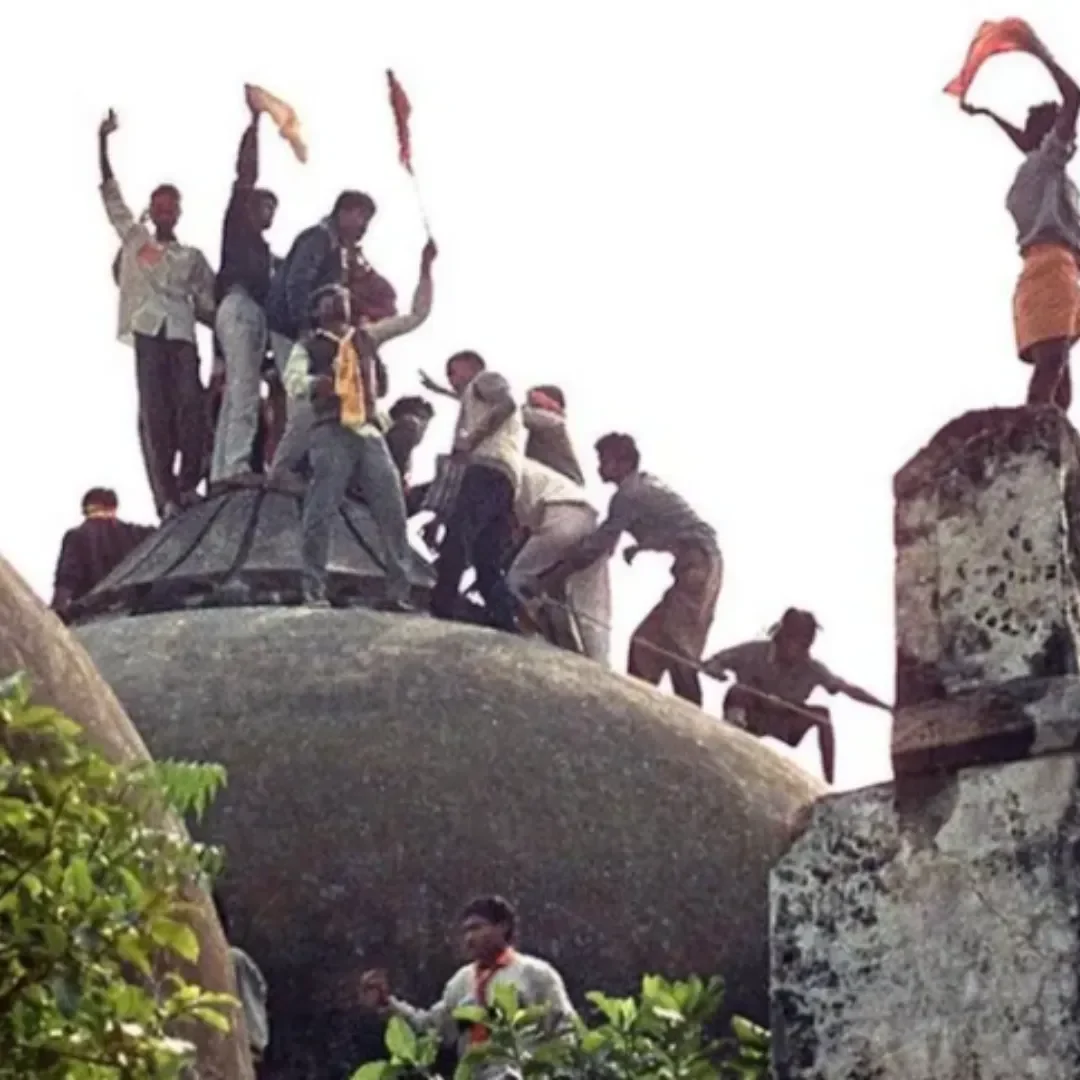
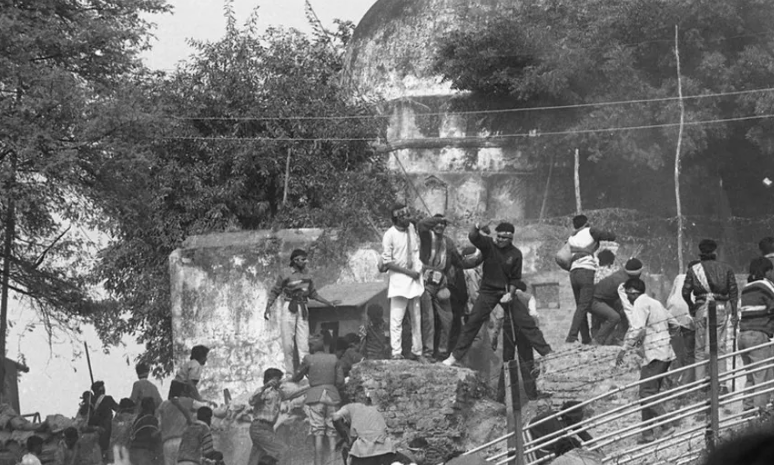
Ayodhya dispute: The religious place located in Ayodhya, Uttar Pradesh, where the Babri Masjid was demolished in 1992.This incident changed the political-social scenario of India.
Ayodhya dispute: The religious place located in Ayodhya, Uttar Pradesh, where the Babri Masjid was demolished on 6 December 1992. It has been a center of controversy between Hindus and Muslims for years. Let’s take a look at its history…
1528: A mosque was built on the site believed by Hindus to be where Lord Rama, one of Hinduism’s most revered gods, was born.
1853: For the first time, a fight broke out between two communities at that place regarding worship.
1859: The British colonial administration erected a fence to separate the places of worship, allowing the inner complex to be used by Muslims and the outer complex to be used by Hindus.
1949: Idols of Lord Ram appeared inside the mosque. Muslims opposed this. Both parties filed a civil suit. The government declared the complex a disputed area and closed the gates.
1984: Hindus gave the slogan of Ramlala we will come, we will build the temple there. Hindus formed a committee, led by the Vishwa Hindu Parishad (VHP), to liberate the birthplace of Lord Ram and build a temple in his honour. The then BJP leader Lal Krishna Advani took over the leadership of the campaign.
1986: Faizabad District Judge orders opening of the gates of the disputed mosque to allow Hindus to worship there. Muslims formed Babri Masjid Action Committee in protest.
1989: VHP intensified the campaign and laid the foundation of Ram temple on the land adjacent to the disputed mosque.
1990: VHP workers partially damaged the mosque. Prime Minister Chandrashekhar tried to resolve the dispute through talks, which failed.
1991: BJP came to power in Uttar Pradesh with full majority. After this the Ram Mandir movement intensified.
1992: Supporters of VHP, Shiv Sena and BJP demolished the mosque, sparking riots between Hindus and Muslims across the country. In which more than 1,500 people were killed.
1998: BJP formed a coalition government under the leadership of Prime Minister Atal Bihari Vajpayee.
2001: Tension increased on the anniversary of the demolition of the mosque. VHP resolved to build a Hindu temple again at that place.
January 2002: Shri Vajpayee established an Ayodhya cell in his office. Appointed a senior officer Shatrughan Singh to hold talks with Hindu and Muslim leaders.
February 2002: BJP refused to commit to the construction of the temple in its manifesto for the Uttar Pradesh assembly elections. VHP set March 15 as the deadline to start construction. Hundreds of volunteers gathered at the spot. At least 58 people were killed in an attack on a train carrying Hindu activists returning from Ayodhya in Godhra.
March 2002: Nearly 1,000 people were killed in riots in Gujarat after the train attack.
April 2002: Three judges of the High Court started hearing to determine the ownership of the religious place.
January 2003: Archaeologists begin survey on court orders to find out whether there was a temple of Lord Ram at the site.
August 2003: The survey said there was evidence of a temple beneath the mosque, but Muslims disputed the finding. Mr Vajpayee said at the funeral of Hindu activist Ramchandra Das Paramhansa that he would fulfill the dying man’s wish and build a temple in Ayodhya. However, he is hopeful that the issue will be resolved through courts and negotiations.
September 2003: A court ruled that seven Hindu leaders should be prosecuted for inciting the demolition of the Babri Masjid, but no charges were brought against Mr Advani, who was present at the site in 1992.
October 2004: Mr Advani said that his party is still committed to the construction of the temple in Ayodhya.
November 2004: An Uttar Pradesh court ruled that an earlier order acquitting Mr Advani of his role in the demolition of the mosque should be reviewed.
July 2005: Suspected terrorists attacked the disputed site. A jeep laden with explosives was used to blow a hole in the wall of the complex. Security forces killed five people, whom they said were terrorists.
June 2009: The Liberhan Commission, investigating the incidents related to the demolition of the mosque, submitted its report, 17 years after starting its investigation.
November 2009: There was an uproar in Parliament when the Liberhan Commission report was published. In this, prominent leaders of the Hindu nationalist BJP were blamed for their role in the demolition of the mosque.
September 2010: Allahabad High Court ruled that the site should be divided, with one-third going to the Muslim community, one-third to Hindus and the rest to the Nirmohi Akhara sect. Control of the main disputed area, where the mosque was demolished, was given to Hindus. A lawyer of the Muslim community said that he would appeal.
May 2011: The Supreme Court stays the High Court’s decision after Hindu and Muslim groups appeal the 2010 decision.
In 2020, the special court acquitted all the accused, saying that the demolition was not planned and happened suddenly.
Also read: Story of Ayodhya! Where faith, politics and history still stand face to face
Live India emerged from a vision to revolutionize digital news consumption in India. What began as a digital initiative has grown into a trusted news source reaching millions of Indians across the nation and Indian diaspora worldwide.